How high can the tennis ball go?
Hold a tennis ball on top of a basketball and let go of both. They fall together, hit the floor, and a moment later the tennis ball shoots up toward the ceiling. Drop them from 1 meter and the tennis ball can climb several meters. The first time you see it, it looks like a magic trick.
It isn't magic, of course. Energy doesn't appear out of nowhere. So where did the tennis ball get all that energy? And how high can it possibly go? In this simulation we will chase the answer using just two tools, momentum and the coefficient of restitution, and see whether we can predict the height before we drop.
This is a classroom classic, sometimes called a "Galilean cannon." But the equations we will use are not just for the classroom. The very same ones turn up in how a nuclear reactor slows its neutrons and in the routes of spacecraft that hop from planet to planet. Learn what happens when something heavy meets something light, and a surprising amount of the world opens up.
Ride on the basketball
Just before they reach the floor, both balls are moving down at the same speed . Falling from height turns potential energy into kinetic energy , so whatever the mass. The basketball hits the floor first and bounces back up. Just above it, the tennis ball is still coming down. So we have a heavy ball going up meeting a light ball coming down, head-on.
Here is a thought experiment. Imagine you are riding on the basketball, and suppose every collision is perfectly bouncy. From where you sit, the tennis ball is coming at you at . The basketball is so much heavier that it acts almost like a solid wall, so the tennis ball bounces off at . But your "wall" is itself moving up at . Seen from the ground, the tennis ball leaves at . Three times the speed means nine times the height, because the height you reach is proportional to the square of your launch speed: .
And the energy? It comes from the basketball. The collision slows the heavy ball a little, and part of its kinetic energy goes to the light ball. The trick is to collect energy from something heavy and hand it to something light.
Notice the trick at the heart of this explanation. "Riding on the basketball" is simply a change of reference frame, the same idea as describing the view from a moving train. Choosing where to stand can turn a hard problem into an easy one.
Two equations for a collision
Collisions were among the very first problems of modern mechanics. In 1644 René Descartes published rules for colliding bodies, but most of them disagreed with experiment. In 1668 the laws of collision were debated at the Royal Society in London, and John Wallis, Christopher Wren and Christiaan Huygens each sent in answers. Huygens also noticed that in elastic collisions the sum of mass times speed squared stays the same, a quantity that grew into our kinetic energy. In his Principia of 1687, Isaac Newton described experiments in which balls hung as pendulums were made to collide, and noted that the speed at which they separate is very nearly a fixed fraction of the speed at which they approach. That observation is the root of the coefficient of restitution. The Newton's cradle simulation tells this story in more detail.
In today's language, we need two tools.
Conservation of momentum. The collision lasts only an instant, so the impulse from gravity during it is negligible. The forces the two balls exert on each other are equal and opposite by Newton's third law, so the total momentum doesn't change:
Coefficient of restitution. The speed at which the balls separate is times the speed at which they approached:
With the collision is elastic and kinetic energy is also conserved; with some of it turns into heat, sound and deformation. For a bounce off the floor, , so the rebound height is : times the drop height. That gives you a neat way to measure : drop a ball and compare heights.
The coefficient of restitution even appears in sports rulebooks. A standard tennis ball of the medium-speed type, dropped from 254 cm onto a rigid surface, must rebound to between 135 and 147 cm. For a floor bounce , so that means –. Golf clubs, too, have a rule limiting how "springy" the face can be.
Now solve the two equations together. Take up as positive: just before the collision the bottom ball, of mass , moves at and the top ball, of mass , at . Call their velocities afterward and . Momentum: . The approach speed is , so restitution says . Substitute into the momentum equation and collect terms: . So the top ball leaves with
With and much smaller than , , just as the thought experiment said. Now put in real numbers: a 0.6 kg basketball and a 0.057 kg tennis ball with give , a height about 7.0 times the drop. It falls short of 9 because the tennis ball's mass is not zero.
Stack more, rise higher, up to a limit
The stacked-ball experiment itself has long been done with very bouncy rubber balls. In 1968 an American journal for physics teachers described stacking Superballs to launch the top one high into the air. Today you can buy a toy called the Astro Blaster, with a rod through the balls to keep them lined up, and the top ball flies off so hard that the toy comes with safety goggles.
Stack more balls, each much lighter than the one below, and you just repeat the argument. If a heavy ball comes up at speed and a much lighter one falls at , the light ball approaches at as seen from the heavy one and bounces off at , so seen from the ground it leaves at . Starting from gives , then , then . With balls the top speed is and the height times the drop: 9, 49 and 225 times for two, three and four balls. Drop the stack from 1 m and the top ball sails 225 m, higher than the roof of a 50-story building. On paper, anyway. Energy conservation still sets a hard limit. All the balls fall from height , so the whole stack has mechanical energy , where is the total mass. Even if every bit of it ended up in the top ball of mass , then , so the top ball could rise to a height of at most times . The speed factors hold only in the ideal limit where each ball is far lighter than the one below; put in real masses and the factor always stays inside this limit. Take this simulation's three balls of 0.9, 0.3 and 0.1 kg: the limit is times, nowhere near the ideal 49. Drop them with and you get about 12, computed with the actual mass ratios rather than the ideal limit. Energy conservation firmly vetoes the 225-meter dream.
Our "ride on the basketball" argument also hides an assumption about order: the bottom ball finishes bouncing off the floor before the top ball hits it. Real balls squash for a moment while they touch, so there is a brief time when the floor, the bottom ball and the top ball are all pushing on one another at once. The simple model in this simulation ignores that time and treats the collisions as happening one at a time.
Collecting energy from heavy balls and handing it to light ones is sometimes used as an analogy when explaining supernova explosions, though the real mechanism of those explosions is far more complicated and is still being researched.
What if we just swap the momenta?
Let's try a tempting shortcut. Momentum is conserved in a collision, so why not say that the two balls simply trade momenta?
Add them up and you get : total momentum really is unchanged. And when the masses are equal, the two balls exchange velocities, which is exactly the correct answer for . It's what happens in Newton's cradle, where the ball at one end stops and the one at the other end flies off. So far the shortcut looks pretty good.
The trouble shows up when you compute the kinetic energy. After the collision it is
which equals the energy before, , only when . Put in numbers. Taking up as positive, let a 0.9 kg ball come up at m/s and a 0.3 kg ball come down at m/s. The kinetic energy before is J. With the swap, the light ball shoots up at m/s, the heavy one ends at m/s, and the kinetic energy is 22.4 J. Nobody did any work, yet the energy went up by a factor of 2.3. With the correct rule and , the formula above gives 8 m/s for the light ball, the heavy ball stops dead, and the energy stays at 9.6 J.
Where did it go wrong? After the collision there are two unknown velocities, and , but momentum conservation gives only one equation. Two unknowns need a second condition. That is the restitution equation, , which describes how fast the balls separate after squeezing each other: a property of the material they are made of. The swap quietly replaces this second equation with a promise to "trade momenta" that has no physics behind it. Satisfying one conservation law does not make a calculation right, so check it against another one. If mechanical energy goes up in a collision with , something in the calculation is wrong.
In this simulation, choosing "Swap momenta (wrong, for comparison)" under "Collision rule" runs this wrong formula, with the restitution coefficient multiplied in as and so on. It is there on purpose, so you can compare it with the correct rule and see how the error gives itself away. Drop the starting setup, a basketball and a tennis ball with , and the "Mechanical energy" graph climbs to about 700 %, while the tennis ball rises more than 50 times the drop height. That blows straight through the energy limit we found above: total mass ÷ mass of the top ball, about 11.5 here. With three balls of equal mass, on the other hand, the motion looks almost the same as with the correct rule. That is what makes this mistake sneaky: looking right in one case does not make a formula right.
Bouncing off a moving wall
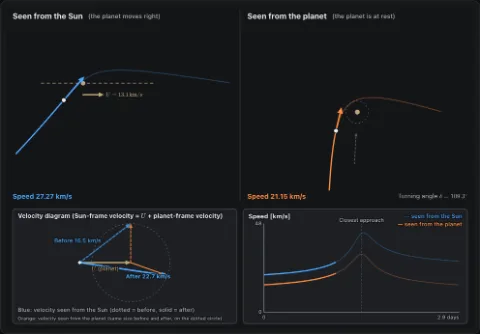
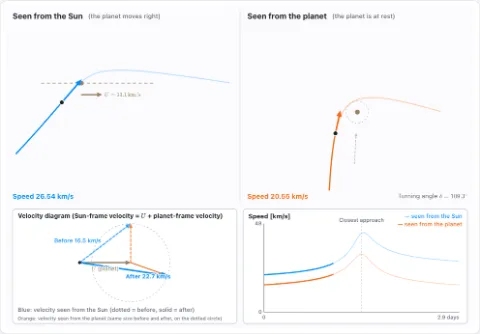
The "bounce off a moving wall" idea also works in space. When a spacecraft swings past a planet, its speed relative to the planet is the same before and after, yet relative to the Sun it can gain a lot. In 1965 Gary Flandro, a Caltech graduate student working part-time at NASA's Jet Propulsion Laboratory, noticed that in the late 1970s Jupiter, Saturn, Uranus and Neptune would line up so that one spacecraft could swing from each to the next, an alignment that comes around only about once every 175 years. Some sources give the year of his discovery as 1964. Voyager 2, launched in 1977, used that chance to visit all four planets in turn. Momentum exchange can even be used to nudge a celestial body: in 2022 NASA's DART spacecraft crashed into Dimorphos, a small asteroid orbiting the asteroid Didymos, and shortened its orbital period by about 32 minutes. The recoil from the debris thrown off is estimated to have given Dimorphos more momentum than the spacecraft itself carried.
Equal masses hand over everything
The same equations tell you how to slow something down. When equal masses collide head-on with , they simply swap velocities. Newton's cradle, the desk toy, shows off this property, and the preset with three equal balls is a vertical version of it.
These equations once led to a discovery that changed twentieth-century physics. In 1934 Enrico Fermi's group in Rome was making elements radioactive by bombarding them with neutrons, and they noticed something odd: the experiment worked better on a wooden table than on a marble one. When they put paraffin wax between the neutron source and the silver, or surrounded both with wax, the induced radioactivity rose sharply; in his Nobel lecture Fermi said it went up, in some cases, as much as a hundredfold. Fermi reasoned that the neutrons were being slowed by collisions with the hydrogen atoms that wax and wood are full of, and he confirmed it with water. A hydrogen nucleus, a proton, has almost the same mass as a neutron, so in a head-on collision the neutron loses much of its energy, the same physics as equal balls swapping velocities in this simulation. The discovery that slow neutrons are captured more readily was part of the work for which Fermi received the 1938 Nobel Prize in Physics, and it led on to nuclear reactors.
In a head-on elastic collision with an equal mass, a particle hands over all its kinetic energy. So to slow neutrons in a nuclear reactor, you bounce them off nuclei of similar mass, which is one reason ordinary water, rich in hydrogen, is used as a moderator. What Fermi found with a wooden table and a block of wax became a design principle for reactors.
Drop them yourself
- Under "Balls (from the bottom)", choose "Basketball + tennis ball". Predict how many times the drop height the tennis ball will reach. Press the purple "⬇ Drop" button, and set the toolbar speed to ×0.1 to watch the collision. Compare "Top ball rise ÷ drop height" with "Simple-model prediction (v/u)²".
- Move the "Coefficient of restitution e" slider to 1, 0.95 and 0.75. The last is close to a real tennis ball. How does the ratio change?
- Read "Impact speed u = √(2gh)" and "Launch speed of top ball v". Is the square of equal to the height ratio?
- Change "Drop height". Does the ratio change? Predict from the formula first.
- Try "3 balls (0.9 : 0.3 : 0.1 kg, bottom up)". How high now? What about "3 balls of equal mass"?
- Choose "Heavier on top (tennis + basketball)". The prediction now says it does not apply. Watch at ×0.1 to see why: the balls collide again and again.
- Switch "Collision rule" to "Swap momenta (wrong, for comparison)" and watch the energy graph. If total energy climbs above 100%, something in the calculation is wrong. To see exactly what is wrong, read the section "What if we just swap the momenta?" The link in the panel note takes you there.
An honest note. In the main view the balls are drawn larger than the height scale; the zoom box at top right is true size. The model ignores air resistance and the time the balls take to squash, and uses one value of for every contact. Real balls fly off sideways and touch more than two at a time, so they never rise quite this cleanly.
From heavy to light
Momentum is conserved in a collision, and the coefficient of restitution is the ratio of separation speed to approach speed; only when is kinetic energy conserved too. When a light ball meets a heavy ball that has just bounced upward, the light ball can leave at up to and rise up to nine times as high. The magic turns out to be energy flowing from the heavy ball to the light one. The height ratio is , and energy conservation sets a limit no stack of balls can beat.
From the seventeenth-century laws of collision to Fermi's slow neutrons, Voyager's tour of the aligned planets and DART's nudge to an asteroid, the same question, how momentum and energy pass between something heavy and something light, has kept driving science and technology.
Something to think about: with four balls stacked, how high could the top one go? And what happens to the bottom ball while that is going on?
Sources and further reading
The facts in this article were checked mainly against these sources.
- Mechanics and the Royal Society, 1668–70 (The British Journal for the History of Science, Cambridge University Press)
- Newton, Principia, 1846 English translation: Axioms, or Laws of Motion, with the Scholium (Wikisource)
- Enrico Fermi – Facts (Nobel Foundation; the 1938 prize citation)
- Fermi, "Artificial radioactivity produced by neutron bombardment," Nobel Lecture (1938, Nobel Foundation; paraffin raising the activity up to a hundredfold)
- The Other Side (Caltech Engineering & Science, Winter 2013; Flandro in spring 1965 and the alignment that recurs about every 175 years)
- Voyager (NASA Science)
- NASA Confirms DART Mission Impact Changed Asteroid's Motion in Space (NASA, 2022)
- Double Asteroid Redirection Test (DART) (NASA Science)
- Cheng et al., "Momentum transfer from the DART mission kinetic impact on asteroid Dimorphos," Nature 616 (2023) (PMC; the ejecta gave more momentum than the spacecraft carried)
- ITF Rules of Tennis 2026 (International Tennis Federation; ball specifications in Appendix I)
- Astro Blaster (Arbor Scientific product page; comes with safety glasses)
- Driver Head Coefficient of Restitution and/or Characteristic Time (on the golf rule)
Further reading (encyclopedia articles):
- Galilean cannon (Wikipedia; includes Mellen's 1968 paper and the Astro Blaster)
- Enrico Fermi (Wikipedia; the wooden table and the paraffin)
- Grand Tour program (Wikipedia; Flandro and the planetary alignment)
- Gravity assist (Wikipedia)
- Double Asteroid Redirection Test (Wikipedia)
- Neutron moderator (Wikipedia)
- Tennis ball (Wikipedia; the 254 cm drop and 135–147 cm rebound specification)