A race between a full can and an empty one
Take a full can of juice and an empty can, put them side by side at the top of a slope, and let go at the same moment. Which one reaches the bottom first?
You might say the heavier one. Or, if you remember that Galileo taught us heavy and light things fall together, you might say "at the same time". Try it, and the full can wins clearly. Now freeze the juice solid and race again. The frozen can is slower than the liquid one, although it holds exactly the same amount of juice!
So something other than weight or size is deciding the race. In this simulation we race six different objects down the same slope and track down that something. The answer is how far the mass sits from the axis of rotation: the moment of inertia.
Curiously, this quantity was not discovered by watching cans roll downhill. It surfaced in the seventeenth century, when people trying to keep accurate time with pendulums ran into a stubborn question: how does a real, solid pendulum swing? Along the way we'll see how a race of cans and the problem of keeping time turn out to be the same story.
Rolling splits the energy two ways
First, think carefully about rolling without slipping. A rolling can moves down the slope, which is translation, and spins at the same time, which is rotation. As long as it doesn't slip, the two are locked together: one full turn moves the can forward exactly one circumference.
Now think about energy. The potential energy it had at the top turns into kinetic energy on the way down. But a rolling object has two places to put kinetic energy: moving forward and spinning. The more energy goes into spinning, the less is left for moving forward, and the slower the object goes.
How much does spinning take? It depends on how fast each part moves. Parts near the center hardly move; parts at the rim move fast. So an object with its mass out at the rim needs much more rotational energy to roll at a given speed. An empty can or a ring has all its mass at the rim, so it is slow. A ball keeps a lot of its mass near the middle, so it is quicker.
Passengers that never spin
Here is the trick of the liquid-filled can. The metal shell spins, but the liquid inside hardly spins at all: the shell can't grip it well enough in the short time of the race. The liquid is simply carried along. Its 350 grams demand essentially no rotational energy; it is a passenger that never asks for a share. Freeze it, though, and the contents must turn with the shell. Now they demand rotational energy too, and the can slows down.
You can see the same trick in the kitchen.
Do you know how to tell a raw egg from a boiled one? Spin them on a table. The boiled egg spins nicely; the raw egg quickly loses speed, because the liquid inside doesn't turn with the shell right away and the rubbing between shell and liquid turns energy into heat. Stop a spinning raw egg with a fingertip for an instant and let go, and it starts turning again: the liquid inside was still turning. As with the liquid can, what matters is that the contents don't turn together with the container.
Mass for rotation
Let's first work out for ourselves how much energy spinning takes. Chop the spinning object into little pieces. A piece of mass at distance from the axis, turning at angular velocity , moves at speed . Adding up the kinetic energies of all the pieces gives
The quantity in parentheses, , is the moment of inertia. It sits exactly where sits in the translational kinetic energy , so it plays the role of "mass for rotation." But it is not simply the total mass: each bit of mass is weighted by the square of its distance from the axis, so mass twice as far out counts four times as much. Why the square? Imagine spinning a weight on the end of a stick by twisting the stick at the axis. A weight far out has to move faster for the same rate of turning, by one factor of . And by the law of the lever, the twist you apply at the axis turns into a weaker push the farther out you go, by another factor of . Two handicaps at once make .
For a ring, all the mass is at radius , so . In a disk the mass is spread evenly from the center to the rim. Slice the disk into thin rings, as in the figure, and add them up. A thin ring between radii and has area , and it carries that fraction of the disk's area of the mass, so its mass is . All of that mass sits at distance from the axis, so multiplying by and adding up gives
Mass near the axis counts for little, however much of it there is. A solid ball keeps even more of its mass near the axis, and its moment of inertia drops to . Treat the ball as a stack of thin disks and add up their in the same way; the integral goes a little beyond high school, so we just use the result. Put translation and rotation side by side and the vocabulary matches neatly:
| Translation | Rotation |
|---|---|
| Mass | Moment of inertia |
| Velocity , acceleration | Angular velocity , angular acceleration |
| Equation of motion | Rotational equation of motion ( is the torque) |
| Kinetic energy | Rotational kinetic energy |
On a slope, only the shape matters
Now let's put it to work on the slope. Let the slope angle be , the mass , the radius , the moment of inertia about the center , and the static friction from the slope . The equations for translation along the slope, rotation about the center, and rolling without slipping are
Put the third equation into the second and you get . Put that into the first: , that is, . The rotation acts as if it added to the mass. Divide by and write :
The number measures how far out the mass is, and it depends only on shape. Both and cancel out. A big ball and a small ball, a heavy one and a light one, all roll down the same slope at the same rate. Race a bowling ball against a marble, and if rolling resistance and air drag are small they should come down side by side. Galileo's "weight doesn't matter" for falling survives in rolling as "only the shape matters."
| Object | Acceleration at 1.5° | Time for 1.5 m | Share of KE in rotation | |
|---|---|---|---|---|
| Liquid can (15 g shell, 350 g contents) | 0.041 | 0.246 m/s² | 3.49 s | 4% |
| Solid ball | 2/5 | 0.183 m/s² | 4.05 s | 29% |
| Solid cylinder | 1/2 | 0.171 m/s² | 4.19 s | 33% |
| Frozen can | 0.521 | 0.169 m/s² | 4.22 s | 34% |
| Empty can, ring | 1 | 0.128 m/s² | 4.84 s | 50% |
For the liquid can, only the shell rotates. It is a thin cylinder with , so . For the frozen can, the contents spin as a solid cylinder too: .
In terms of energy, after dropping a height , and using and ,
so the speed at the bottom is . The fraction of kinetic energy that goes into rotation is : half of it, for a ring.
Friction that does no work
Wait a moment, you might say. Rolling needs friction. Doesn't friction waste energy? Here is the nice part. When an object rolls without slipping, the point touching the slope is momentarily at rest, and a force on a point that isn't moving does no work. So static friction wastes nothing; it just redistributes energy from translation into rotation. If there isn't enough friction, though, the object slips. Put back into the translation equation and the friction needed is . Static friction can be at most , so gives the condition for rolling without slipping, .
What Galileo's ramp was hiding
A ball rolling down a slope may remind you of a famous name.
Galileo Galilei studied motion with balls rolling down inclines. His Two New Sciences, published in Leiden in 1638, describes a wooden beam several meters long with a parchment-lined groove, down which he rolled a hard, smooth, very round bronze ball, timing each run by weighing the water that ran out of a thin pipe in a raised vessel. Free fall was too quick to time with the tools of the day, so the slope "diluted" gravity. Over many runs, he found that the distance grows as the square of the time.
Galileo did not account for the rolling; there was no concept of energy yet. Still, his conclusion was right. A rolling ball accelerates only as fast as a frictionless sliding block, since , but at a constant rate. Even his assumption that descending the same height gives the same speed on any slope holds, since at every angle; only the speed itself is of the sliding value. When a law's shape is right but its numbers are off, something without a name is usually hiding.
From pendulum clocks to the insides of planets
Clocks dragged it into the open. Christiaan Huygens patented the pendulum clock in 1657. An accurate clock needs an accurate period, but theory could handle only an ideal pendulum: a point weight on a weightless string. Which ideal pendulum does a real one, rod and bob and all, swing like? This "center of oscillation" problem had been posed by Marin Mersenne, the French scholar the young Huygens corresponded with, and René Descartes and Gilles de Roberval had both attacked it and come to different answers.
Huygens solved it in his Horologium Oscillatorium of 1673, using the principle that weights moving under gravity alone can never lift their common center of gravity above its starting height, an early form of energy conservation. Applied to a pendulum treated as a collection of weights, it produces a sum of each mass times the square of its distance from the pivot: our . In today's notation, a solid pendulum swings like an ideal one of length , with the distance from the pivot to the center of mass. The same "adding up the energy" that decides our can race was solving the clockmaker's problem. Huygens's formula for the solid pendulum still works today for a playground swing or a grandfather clock.
Leonhard Euler gave the quantity its name, momentum inertiae, in his 1765 book on the motion of rigid bodies, Theoria motus corporum solidorum seu rigidorum, where he built a theory that treats rotation with equations, in the same grammar as translation, as in the table above. A quantity born from worries about clock accuracy became a foundation for the mechanics of everything that turns, from tops and wheels to planets.
The moment of inertia even lets us look inside the Earth. The Earth's , which geophysicists write as , is 0.3307, less than the 0.4 of a uniform ball, because its dense core concentrates mass near the center. The value comes from combining the rate at which the Earth's spin axis slowly circles like a top's, called precession, with the slight flattening of its gravity field, measured by tracking satellites. The Moon's value, 0.393, is close to that of a uniform ball, a sign that its core is small; Mars comes in at 0.364. Mapping a planet's gravity from an orbiting spacecraft is a way of looking inside it without cracking it open.
Putting rotational inertia to work
Rotation is also a place to store energy. A spinning object holds , so for a given mass, putting the mass at the rim stores more: that is a flywheel. Flywheels have long smoothed out engines, and now they also help manage electricity. In Stephentown, New York, a plant with 200 carbon-fiber flywheels in underground housings began operating in 2011, with an output of 20 MW. It soaks up power when the grid has too much and returns it when there is too little, holding the frequency steady.
The electricity in your wall socket is protected by moments of inertia too. In fossil-fuel, nuclear, and hydroelectric stations, huge turbines and generators spin in step with the grid frequency: 60 Hz in North America, 50 Hz in Europe and eastern Japan. If a station suddenly drops out, the machines begin to slow and the frequency falls; the rotational energy stored in all those large values of flows out as electricity, slowing the fall and buying a few seconds for the controls to respond. Power engineers literally call this "inertia." Solar panels and modern wind turbines connect through power converters called inverters, so on their own they provide little of it. Engineers are teaching inverters to respond fast enough to do the same job, or adding spinning machines just for their inertia. Bringing more renewables onto the grid is partly a moment-of-inertia problem.
To accelerate quickly, on the other hand, you want the spinning parts light, especially on the outside. A bicycle's rim and tire act like a ring with , so when you start pedaling they resist speeding up as if they had about twice their mass. Choking up on a baseball bat makes it easier to swing for the same reason: the mass sits closer to your hands, the axis of the swing.
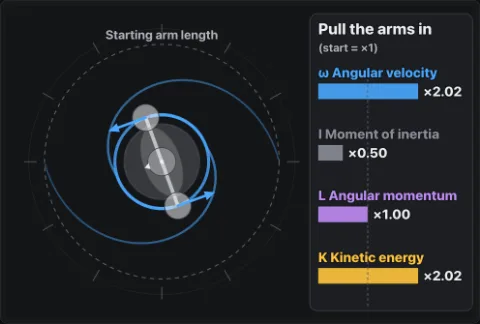
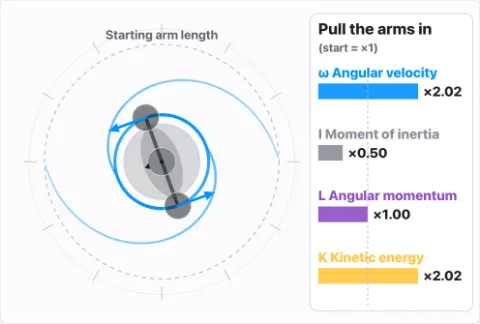
A figure skater who pulls in her arms spins faster because her moment of inertia drops, as you can try in the spinning-chair simulation. A yo-yo falls slowly because winding the string on a thin axle makes its very large.
Race them yourself
- Choose your answer under "Prediction: which arrives first?", then press "🏁 Start all together". Each press resets the toolbar time to 0, so is the time since the start. The result appears at the top of the picture.
- Compare the finishing times of the empty can and the ring in the last two lanes. Why are they equal when the shapes are so different?
- Set "Slope angle" to 30° and race again. Does the order change? At 1.5° the ratio of the empty can's time to the cylinder's time was 1.155. Does that ratio change? Predict it from .
- Lower "Mass of the contents" toward 0 g. What happens to k for the can of liquid and the frozen can?
- Watch the bars on the right as the green potential energy turns into blue translational and purple rotational energy. Setting the playback speed in the toolbar to ×0.25 helps.
- Look at "Friction coefficient needed to roll without slipping (max)" under "Results (calculated)". What happens to it as the slope gets steeper?
What the model assumes: rolling without slipping, with no rolling resistance or air drag. The liquid does not rotate with the can at all; a real liquid slowly starts to turn over longer distances. The can is a thin cylinder without lids or a bottom; including them would make a little less than 1.
What decided the race
The moment of inertia falls straight out of adding up the energy of rotation, and it plays the part of mass for spinning. An object rolling without slipping accelerates at , and depends only on how the mass is distributed, not on the mass or the radius. Potential energy splits between translation and rotation, with a fraction going into rotation, and the more rotation takes, the slower the object. The liquid can wins because its contents don't spin and take almost no rotational energy.
This quantity stayed hidden in Galileo's rolling-ball experiments, surfaced in Huygens's calculation of the period of a pendulum clock, and was named by Euler, who made it a foundation of the mechanics of rotation. Today it sits inside flywheels and power-station turbines, helping to hold steady the frequency of the electricity that reaches your home.
A last puzzle: how fast would a can roll if its contents were frozen only near the wall, with liquid still in the middle?
Sources and further reading
The facts in this article were checked mainly against these sources.
- Denholm et al., Inertia and the Power Grid: A Guide Without the Spin, National Renewable Energy Laboratory, 2020
- Arseneaux, 20 MW Flywheel Frequency Regulation Plant (Stephentown NY), Beacon Power, U.S. Department of Energy Energy Storage Systems Peer Review, 2012
- June 16, 1657: Christiaan Huygens Patents the First Pendulum Clock, APS News, American Physical Society, 2017
- Babeș, Descartes and Roberval: The Composite Pendulum and its Center of Agitation, Journal of Early Modern Studies, 2018
Further reading (encyclopedia):