Why does the swinging slosh back and forth?
Take two pendulums of the same length and join them with a weak spring. Pull the left one aside and let go. At first only the left one swings. Wait a little, and the right one starts to stir; before long the left one has almost stopped and the right one is swinging hard. Wait some more, and the swinging comes back to the left. The two pendulums seem to be playing catch with their motion.
A second experiment. Hang a row of pendulums of different lengths from one string and set just one of them, a heavy one, swinging. Gradually, only the pendulum with the same length begins to swing strongly. The others hardly move.
Why does the motion slosh back and forth? Why is the pendulum of the same length "chosen"? In this simulation the computer solves the pendulums' equations of motion, and we use it to puzzle out both mysteries. One of the first people to record that linked pendulums influence each other, more than 350 years ago, was a scientist stuck in his room with an illness. We'll come to his story.
Two special ways to swing
Start with the two connected pendulums. They have two special ways of moving. When both swing the same way by the same amount, in phase, the spring is never stretched, so each behaves like an ordinary pendulum. When they swing in opposite directions, out of phase, the spring stretches and squashes and adds extra restoring force, so this motion is slightly faster. These are the normal modes, and a system started in a normal mode keeps the same shape for ever.
For two identical pendulums of mass and length , with a spring of constant between the bobs, the angular frequencies of the normal modes for small swings are in phase and out of phase. Where does the come from? If the bobs move in opposite directions by each, the spring is stretched or squeezed by , so each bob feels a force on top of the pendulum's own restoring force . Then , so . In phase, the spring never changes length, so drops out.
What the game of catch really is
What if only the left pendulum is pulled aside? "Left only" is exactly half in-phase plus half out-of-phase: add them and the right-hand parts cancel while the left-hand parts add. The two modes have slightly different frequencies, so they slowly drift out of step. When they are half a cycle apart, the left-hand parts cancel and the right-hand parts add. That is the game of catch: beats. If two people clap at very slightly different tempos, they drift from perfectly together to completely out of step and back again, slowly. The two normal modes drift in and out of step in just the same way.
Starting with only the left one displaced by is the same as adding the in-phase motion and the out-of-phase motion . At the left is at and the right at 0. Adding them gives and . Rewriting the sums as products with the sum-to-product identities, the angles become
A fast oscillation at has a slowly changing amplitude. The slowly varying amplitude reaches zero when , so the energy passes completely from left to right in a time and returns after the beat period . A weaker spring makes smaller and the exchange slower.
These formulas rely on the small-swing approximation. The simulation does not: it solves the full equations of motion of the pendulums, the spring and the support, derived from a Lagrangian, numerically with the RK4 method. With large starting angles you can see small departures from the formulas. Without damping, the total mechanical energy is conserved.
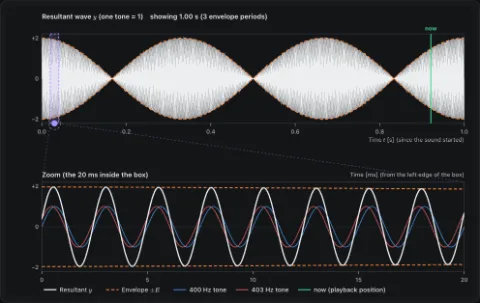
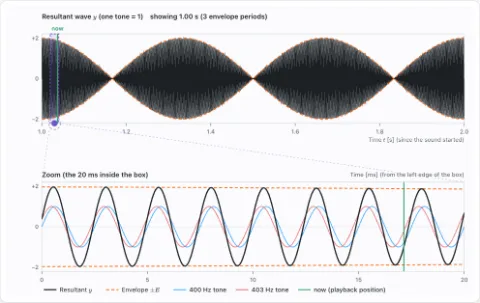
Play two notes with slightly different frequencies and the sound grows louder and softer. These are sound beats, described by the same factor , and it's why musicians tune by adjusting until the beats disappear.
Energy trading is not limited to pairs of pendulums. In the late nineteenth century the Wilberforce pendulum was devised, in which a mass on a spring trades energy between bouncing up and down and twisting; it remains a beautiful demonstration of coupled oscillation.
The clocks' odd kind of sympathy
Late in the winter of 1665, Christiaan Huygens was ill and confined to his room for a few days. Hanging side by side in the room were two pendulum clocks of his own design, prototypes of marine clocks meant for finding longitude at sea. Watching them, he noticed something odd: within about half an hour, the two pendulums always ended up swinging in step but in opposite directions. Huygens called it "an odd kind of sympathy" and put it down to tiny, almost imperceptible motions passed between the clocks through the beam they hung from. He hoped that two clocks keeping each other in line might make a reliable timekeeper at sea; that hope came to nothing. Still, it became one of the earliest records of coupled oscillators falling into step, which is called synchronization. In 2002 a group of American researchers mounted two pendulum clocks on a common platform, reproduced the effect, and explained it with a mathematical model that treats the pendulums' motion as a combination of the in-phase and out-of-phase normal modes. Unlike the pendulums in this simulation, a clock's pendulum is kept going by its drive, a weight or a spring, while friction drains its swing, so instead of trading energy back and forth forever, the pair settles into one pattern of motion. For Huygens's clocks, that pattern was out of phase.
Falling into step is not just something clocks do. Unexpected coupling can also make things worse. London's Millennium Bridge opened on June 10, 2000, but pedestrians' footsteps fell into step with the bridge's sideways sway, the sway grew, and the bridge was closed two days later. It reopened in 2002, after dampers were fitted.
Every vibration is a sum of normal modes
How should we think about coupled vibrations in general? The idea used throughout this simulation, that any motion is a superposition of normal modes, is usually credited to the eighteenth-century Swiss scientist Daniel Bernoulli. He showed that for a row of identical masses joined by springs, like a string chopped into pieces, the motion is a sum of simple sinusoidal patterns, and in 1753 he argued that any vibration of a stretched string is such a superposition. Leonhard Euler doubted that a sum of sines could represent an arbitrary shape, and the argument dragged on. Settling it took the work of Joseph Fourier and others in the nineteenth century. Today we know that any small vibration can be written as a sum of enough normal modes.
The vibrations of atoms in a molecule can be understood as normal modes of masses joined by springs, and they set the infrared frequencies the molecule absorbs. Stranger still are elementary particles. Neutrinos change type as they travel, which is called neutrino oscillation. Mathematically, this is described by a superposition of two states with slightly different frequencies, which swap back and forth like beats, the same kind of equations as the coupled pendulums. In 1998 the Super-Kamiokande group in Gifu, Japan, announced evidence for it, and Takaaki Kajita shared the 2015 Nobel Prize in Physics with Arthur McDonald of Canada. The pendulums' game of catch reaches surprisingly far.
Only the matching pendulum swings
Now back to the second mystery, Barton's pendulums. When the heavy pendulum swings, the shared string, represented here by a support that can slide sideways, is shaken slightly, in time with the heavy pendulum. For every other pendulum that shaking is a push that repeats periodically. Think of pushing a swing: push in time with its motion and it goes higher and higher; push at the wrong rhythm and nothing much happens. Only when the period of the push matches the pendulum's own natural period do the pushes add up. That is resonance.
The row of pendulums of different lengths on one string is called Barton's pendulums, after the English physicist Edwin Barton, who lived from 1858 to 1925, and it is still a favorite way to show resonance.
The natural period of a pendulum for small swings is . It depends only on the length , not on the mass, so "same length" means "same natural period".
Resonance follows from the equation of a driven oscillation. With the position of the support and a damping rate, a light pendulum obeys, for small swings,
When oscillates at the heavy pendulum's frequency it acts as an external driving force, and the response is largest when that frequency is close to .
The body of a string instrument and the resonance box under a tuning fork use resonance to make the sound louder, and some instruments have strings that nobody plucks, which ring in sympathy with the others.
Using resonance, and taming it
When the period of shaking from an earthquake or the wind is close to a building's natural period, the swaying grows. So some tall buildings carry a mass tuned to the building's period, which draws energy out of the building and damps it. Taiwan's Taipei 101 has a pendulum weighing about 660 metric tons. Tokyo Skytree goes further. A reinforced-concrete cylinder about 8 m across and 375 m tall, the "shinbashira," runs up the center of the tower; its upper part is separated from the main structure and linked to it through dampers that absorb energy. In an earthquake the heavy column and the tower sway out of step, partly canceling each other's motion. The tower's operator says this cuts earthquake sway by up to 50%, and the sideways force on the tower in a major earthquake by about 40%. The name comes from the central pillar of a Japanese five-story pagoda. Here the energy exchange you see in the simulation is put to work stopping motion.
Electrical circuits use resonance constantly. The receiver in a radio uses the resonance of a coil and a capacitor to pick one frequency out of the crowd of radio waves. Inside a phone, filters built on tiny vibrating piezoelectric resonators let through only the frequencies the phone uses. In 2007 a group at the Massachusetts Institute of Technology let two copper coils resonating at the same frequency exchange energy, and lit a 60 W light bulb more than 2 m away, with about 40% efficiency. It's the pendulums' game of catch, played with electrical oscillations.
One caution: the 1940 collapse of the Tacoma Narrows Bridge in the United States is often presented as resonance, but it is now understood as a self-excited oscillation called flutter, in which the wind's force changes in response to the bridge's own motion. That is different from simple resonance, where something pushes at a fixed period.
Set them swinging yourself
- The page opens on the coupled pendulums, with only the left one swinging. Watch the energy bars in the strip at the bottom of the canvas as energy moves to the right pendulum. Predict first: how many seconds until the transfer is complete? Compare with the full-energy-transfer time shown on the right of the strip.
- Press In phase (mode 1) and Out of phase (mode 2). Does any energy exchange happen? Compare the Angle [°] graph in the panel with the start from Swing one only.
- Double Coupling spring constant k. What happens to the beat period? Predict, then check.
- Set Right pendulum length (left is 1.00 m) to 0.8 m and press Swing one only. Does all the energy transfer? How does the difference in natural period matter?
- Switch Coupling to Hung from a sliding support. Do beats still occur?
- Set Show to Barton's pendulums (resonance) and press ↔ Start swinging. Watch the amplitude bars at the bottom to see which pendulum grows. It takes tens of seconds, so ×2 playback speed in the toolbar helps. Then change Heavy pendulum length to 0.55 m or 1.00 m.
- Increase Damping rate γ of the light pendulums. What happens to the resonant amplitude?
- Set Show to Four of equal mass (2.0, 3.3, 2.0, 0.7 m). When the driven pendulum is no heavier than the others, how does the energy move?
Fine print: the bobs are point masses and the strings are light rigid rods. The shared string in Barton's pendulums is approximated by a sliding support held by springs. Air resistance is included only for the light pendulums in Barton's setup, as the damping rate .
What the pendulums' game of catch teaches
Two connected pendulums have two normal modes, in phase and out of phase, and any motion is a combination of them. Starting with one pendulum gives beats at the difference of the mode frequencies, and the energy transfers completely in . A pendulum pushed periodically swings strongly only when the push matches its natural period : that is resonance.
The "sympathy" Huygens saw between two clocks from his sickbed is now understood by starting from Bernoulli's idea that every vibration is a superposition of normal modes. Today the same ideas damp the sway of tall towers, tune radios, send power wirelessly between coils, and even help us understand neutrinos.
One step further: with three pendulums joined in a row by springs, how many normal modes are there, and what does each one look like?
Sources and further reading
The facts in this article were checked mainly against these sources.
- June 16, 1657: Christiaan Huygens Patents the First Pendulum Clock, APS News, American Physical Society, 2017
- The secret of the synchronized pendulums, Physics World
- J. O. Smith, Daniel Bernoulli's Modal Decomposition, CCRMA, Stanford University
- A. R. Willms et al., Huygens' clocks revisited, Royal Society Open Science, 2017
- M. Bennett et al., Huygens's clocks, Proceedings of the Royal Society A 458, 2002
- Structural Design, Tokyo Skytree official website, Tobu Tower Skytree
- About Tokyo Skytree (in Japanese), Tokyo Skytree official website, Tobu Tower Skytree
- Tokyo Skytree: traditional beauty and the latest technology (in Japanese), nippon.com, 2012
- Goodbye wires!, MIT News, 2007 (on Kurs et al., Science 317)
- A. Kurs et al., Wireless power transfer via strongly coupled magnetic resonances, Science 317, 2007
- K. Y. Billah and R. H. Scanlan, Resonance, Tacoma Narrows bridge failure, and undergraduate physics textbooks, American Journal of Physics 59, 1991
- Why Professor Takaaki Kajita received the Nobel Prize in Physics, University of Tokyo
- Takaaki Kajita's Nobel Prize, Super-Kamiokande official website, Institute for Cosmic Ray Research, University of Tokyo
Further reading (encyclopedia):