Does an outfielder solve equations?
Crack! A fly ball soars into the sky. The outfielder starts running almost at once and the ball drops neatly into the glove. Think about how odd that is. To find where the ball will land you need its launch speed and angle, and then you need to solve the equations of a parabola. Nobody believes outfielders solve quadratic equations in their heads while sprinting.
The most natural guess is that the fielder judges the landing point from the first moments of flight, runs there, and waits. But studies that filmed outfielders found that they do not run in a straight line to the landing point; they tend to run along a curved, crescent-shaped path. If you already knew where the ball would come down, wouldn't you just run straight there?
So what are they looking at? One answer is astonishingly simple: "move so that the tangent of the angle at which you look up at the ball, , keeps increasing at a constant rate." Do that and you arrive where the ball comes down, without ever knowing where that is. A physicist pointed this out in 1968, and psychologists have spent the half-century since testing and arguing about it, with shoulder cameras and even virtual reality. Can it really work? Let's check, using the equations of projectile motion and the fielder's line of sight.
Why predicting the landing point is hard
First, try the natural guess: predict the landing point. If the bat and the fielder's eyes are at the same height and there is no air resistance, the vertical motion returns to zero at for a launch angle . Meanwhile the ball travels sideways at , so the range is
using the double-angle formula . With m/s and , m. But is proportional to , and , so misjudging the speed by just 3%, say taking a 108 km/h hit for a 105 km/h one, throws the range off by about 6%, more than 5 m. And real fly balls feel air resistance, so they fall well short of this formula. Calling the landing point from the first glimpse is much harder than it looks.
What you see from the landing point
Describe how high the ball looks to the fielder by its elevation angle . If the ball is a height above the fielder's eyes and a horizontal distance away, then .
Start with a fielder standing exactly at the landing point. Just after the hit the ball is far away and low, so is small, and it grows as the ball rises. Fine. The interesting part is the second half of the flight. As the ball comes down, shrinks, but so does . Both head toward zero, so you cannot tell what does without calculating. The calculation, coming up shortly, says keeps growing exactly in proportion to time: to someone at the landing point, it rises at a perfectly steady rate.
Let's do that calculation. The key quantity will be , the time left before the ball returns to eye level. Put the origin under the point of contact, toward the fielder and upward. Take the bat height and the fielder's eye height to be the same, , and write . Without air resistance, and .
Writing shows that at and at : that is when the ball returns to eye height, at the landing point . Putting back in factors as . For a fielder at the landing point the horizontal distance is , so
The factor cancels and is proportional to , with a constant rate . The height and the horizontal distance both shrink in step with the time remaining, so the time remaining cancels out of their ratio.
The whole story rests on combining steady horizontal motion with uniformly accelerated vertical motion. Because the two directions can be handled separately, factoring is enough to see what is going on.
Just keep the rate steady
What if you stand too close to the batter? The ball will fly over your head, so near the end approaches 90° and shoots up faster and faster: its rate of increase grows. Stand too deep and the ball lands in front of you, so the rate of increase shrinks.
That gives a strategy: if the rate is growing, back up; if it is shrinking, come in. Keep the rate steady and, when the ball comes down to eye level, you will be right there. The beauty of it is that it uses only what the eyes can actually pick up. Your eyes cannot directly measure the distance to the ball or its speed, but the direction in which you see it, and how that direction is changing, you get just by following it with your gaze.
On the mathematical side, the heart of the argument is a modest piece of algebra, the cancellation of . With calculus you can compute yourself and see why it grows or shrinks when you stand in the wrong place. The humble tangent of trigonometry becomes a ruler for measuring how things look.
Now run the argument backward. Suppose the fielder decides to keep and is always at the position where that holds. Since ,
When the ball comes down to eye level, while stays non-zero, so : the fielder is guaranteed to be where the ball is at the moment it arrives. This step never used the shape of the trajectory, so it still works with air resistance. You really don't need to know the landing point. A bonus: work out without air resistance. If the fielder starts at , then just after the hit and the horizontal distance is about , so the rate measured there is . With and ,
That is linear in , so the fielder runs at constant speed.
With air resistance the ball comes down more steeply than it went up, so the path is no longer symmetric and the landing point moves closer, yet the constant-rate strategy still works.
The air resistance in this simulation is a force proportional to the square of the speed, with , using typical values for a baseball and integrated numerically with RK4. To be honest, real fly balls are also pushed around by spin, through the Magnus effect, and by wind, so this too is an approximation.
Keeping the rate steady means keeping the optical acceleration at zero, so the strategy is called optical acceleration cancellation, or OAC. It turns a prediction problem into a control problem: hold something about the view constant. Whether people can actually sense optical acceleration accurately is another matter, and that doubt drives the story in the next section.
Do fielders really run this way?
The strategy was first analyzed as a physics problem by the American physicist Seville Chapman, in a three-page paper titled "Catching a Baseball" in the American Journal of Physics, a journal for physics teachers, in 1968. Assuming a parabola without air resistance, he showed that moving so that grows at a constant rate brings you to the landing point.
The question "do people really do this?" became a psychology question in the 1990s. In 1992 Claire Michaels and Raôul Oudejans in the Netherlands studied people running to catch balls and reported support for the idea that they zero out optical acceleration. In 1996, in Britain, Peter McLeod and Zoltan Dienes filmed skilled fielders running forward or backward to catch balls launched by a bowling machine 45 m away. The fielders ran at just the speed that kept the acceleration of the tangent of their gaze angle at zero.
In 1995 Michael McBeath and colleagues in the United States offered a challenge in Science. They recorded dozens of fly balls with a video camera on a tall tower in the outfield and with cameras mounted on the fielders' shoulders. The fielders ran along crescent-shaped arcs, and from the shoulder cameras the ball appeared to rise along a nearly straight line. Since people seem poor at judging accelerations, they proposed the LOT model: the fielder runs so that the ball's image traces a straight line in the field of view. In 2004 the same group put tiny cameras on the heads of a springer spaniel and a border collie and reported that dogs catching Frisbees use similar visual cues.
In 2009 Philip Fink, Patrick Foo and William Warren at Brown University tried to settle the matter. The two models predict nearly the same running paths for ordinary fly balls, which makes them hard to tell apart, so the researchers used virtual reality to quietly change the ball's vertical motion in mid-flight. The running of twelve college baseball and softball players matched OAC and disagreed with LOT and with landing-point prediction. Even so, exactly which cues people combine, and how, is still not completely settled. It is a lovely example of physics wandering into the question of how people move.
Shortcuts that steer by the view
Sailors are taught that if another ship's bearing, the direction you see it in, stays constant while it gets closer, there is a risk of collision; the international rules for preventing collisions at sea say so explicitly. As with the outfielder, the change in how something looks is used to judge its future position without computing it.
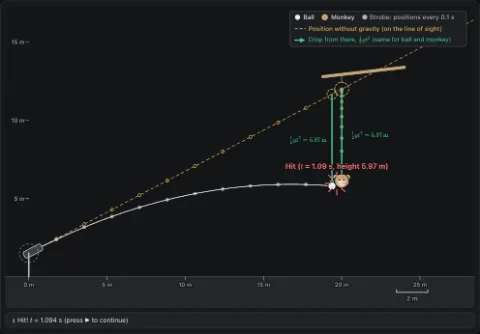
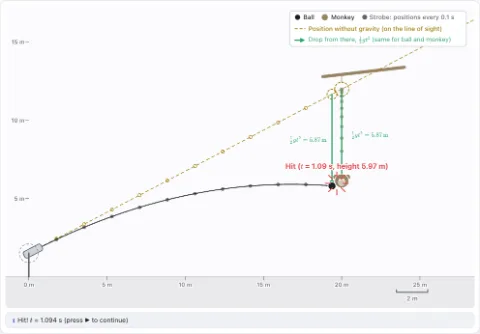
This rule links to the monkey and hunter problem, too. There, the monkey seen from the ball always stays in the same direction, along the original line of sight, as it approaches, and the two always collide. That is exactly the sailor's rule: constant bearing means collision. Keeping a direction constant and running into something are two sides of the same coin.
Turn the idea around and you get a way to hit things. Most guided missiles fly by proportional navigation: they turn at a rate proportional to the rate at which the target's direction changes. In 2017, researchers at the University of Oxford fitted peregrine falcons with GPS loggers and small cameras and found that the final phase of their attacks is very well described by this same guidance law. They suggested it could be used in small drones designed to catch rogue drones. Robots that track moving objects with a camera also steer by viewing angles and how they change.
In psychology, the outfielder's strategy is a standard example of a heuristic, a simple rule that uses very little information and still works well. The German psychologist Gerd Gigerenzer called one version the "gaze heuristic": when the ball is already high in the air, fix your gaze on it, start running, and adjust your running speed so that the angle of gaze stays constant. Our brains, it seems, know a lot of good shortcuts.
When you remember that dogs and falcons seem to use similar strategies, you can see physics, psychology, biology and engineering all meeting over this small question.
Meanwhile modern professional baseball measures everything. Since 2015, Major League Baseball has used the Statcast tracking system in all 30 ballparks; among other things, it computes the probability that a given fly ball can be caught from the distance the fielder must cover and the time available. An outfielder's "feel" can now be checked against data.
Catch one yourself
- Press ⚾ Hit. Each press resets the toolbar time to 0, so is the time since the hit. How the fielder moves starts on Keeps tanθ rising steadily (auto). In the tanθ over time graph at the lower left, watch the yellow line, the fielder's , trace the dashed line, which is the initial rate kept constant.
- Look at the Fielder speed [m/s] graph at the bottom of the panel. Predict first: does the automatic fielder speed up or slow down? Compare with Automatic fielder speed (theory, no air resistance) under Results.
- Switch How the fielder moves to Stands still, set Fielder starting position (from the batter) about 10 m short of the landing point, say 59 m, and hit. Predict: does the curve bend above or below the dashed line? Then try standing 10 m too deep, say 80 m. Watch which way the bar at the lower right, , moves away from its Initial mark.
- Turn on Air resistance (baseball, Cd = 0.35). How much shorter is the hit? Does the automatic fielder still catch it? Is its speed still constant?
- Choose Move it yourself (drag, up to 9 m/s) and drag the fielder during the flight, trying to keep the bar level with the Initial mark. The fielder chases your pointer at up to 9 m/s.
- Change Launch speed v₀ and Launch angle α to find a hit that cannot be caught even at 9 m/s.
Fine print: the bat height and the fielder's eye height are both taken as 1.5 m. The ball and fielder are drawn larger than life, but their positions are exact. Air resistance uses a typical drag coefficient, , and ignores spin and wind.
Hold the view instead of predicting
Predicting the landing point from the first moments of flight is hard. But seen from the landing point, grows in proportion to time; without air resistance the rate is . Stand too close and the rate grows, stand too deep and it shrinks, so the rule is simply to move so that the rate stays constant. Keeping means standing at , and when the ball reaches eye level and you are exactly at the ball, even with air resistance.
What began as a short physics paper in 1968 has grown into shoulder cameras on outfielders, dogs chasing Frisbees and virtual-reality experiments, and it turns out to share its shape with the rules that keep ships apart, with missile guidance and with a falcon's dive. Rather than predicting, keep the view steady. Nature, people and machines all seem to use this shortcut.
One step further: what if the ball is hit off to one side rather than straight at you? Now both the elevation and the sideways direction change. What feature of the view would you try to keep steady then? And a ball hit straight at you gives only up-and-down cues. Would that make it easier to catch, or harder?
Sources and further reading
The facts in this article were checked mainly against these sources.
- Michaels & Oudejans, "The Optics and Actions of Catching Fly Balls: Zeroing Out Optical Acceleration," Ecological Psychology 4 (1992) (Vrije Universiteit Amsterdam research portal)
- McLeod & Dienes, "Do fielders know where to go to catch the ball or only how to get there?" Journal of Experimental Psychology: Human Perception and Performance 22 (1996)
- Catching fly balls: a simulation study of the Chapman strategy (Vrije Universiteit Amsterdam research portal; discusses Chapman's 1968 paper)
- Catcher of the Fly (Discover; on McBeath and colleagues' 1995 study)
- Dogs Catching Frisbees (Science News; on the 2004 study)
- For Most Outfielders, Luck Has Nothing to Do with Catching Flies (Brown University news, 2010; the virtual-reality study by Fink, Foo and Warren)
- Brighton, Thomas & Taylor, "Terminal attack trajectories of peregrine falcons are described by the proportional navigation guidance law of missiles," PNAS (2017) (PubMed)
- International Regulations for Preventing Collisions at Sea (International Maritime Organization)
- COLREG Rule 7: Assessing Risk of Collision (text and commentary)
- 33 CFR 83.07, Risk of collision (U.S. Inland Navigation Rules, Cornell Legal Information Institute)
- Catch Probability (MLB glossary)
- Statcast (MLB glossary)
Further reading (encyclopedia articles):