Where adding gives less
Throw one pebble into a pond and you get a ring of ripples. Now throw two at the same moment, a little apart. What happens? You might expect "twice the ripples, twice the mess".
But look carefully and you'll see lines fanning out along which the water heaves strongly, and other lines along which it hardly moves at all. We added two waves together and in some places got nothing. Isn't that a little strange?
This is interference. It happens with water waves, sound, light, and even electrons. And that odd little fact, that adding can give you less, is what eventually tipped a two-hundred-year-old argument about what light is. Here we'll compute the overlap of two circular waves, work out for ourselves where they reinforce and where they cancel, and see why that matters so much.
The path difference decides
Pick one spot on the water, call it P. Waves from S₁ and from S₂ both arrive there, but there is only one water surface. So the height of the water at P is the sum of the two displacements. This is the principle of superposition. To be honest, it's an approximation that works when the ripples are small; waves big enough to break don't add so politely. A crest plus a crest gives a bigger crest, a trough plus a trough a deeper trough, and a crest plus a trough gives zero.
So where do crests meet crests? A wave repeats itself every wavelength . If the trip from S₁ to P is longer than the trip from S₂ to P, the wave from S₁ arrives "late" by that extra distance, the path difference . If it is exactly , , ..., the delay is a whole number of cycles and the waves arrive in step. If it is , , ..., a crest from one source always shows up with a trough from the other.
A thought experiment: put P on the perpendicular bisector of S₁S₂. The path difference is zero, so the waves always reinforce. Slide P sideways: the path difference grows, the waves cancel at and reinforce again at . Join up all the points that share the same path difference and you get a hyperbola with S₁ and S₂ as its foci. The lines of strong motion, called antinodal lines, and the lines of stillness, called nodal lines, all belong to this family of hyperbolas.
Now try an unfair comparison: scatter sand from two bags instead. There's no such thing as a negative grain of sand, so opening the second bag gives every spot more sand, never less. Waves are different because a displacement has a sign: crests are positive, troughs negative, so two of them can add up to zero. "Turn on a second source and some places get quieter" is something a simple stream of particles can't do. It is a fingerprint of waves.
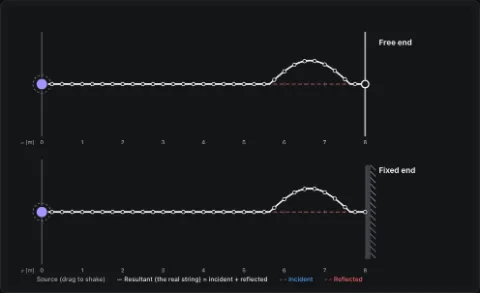
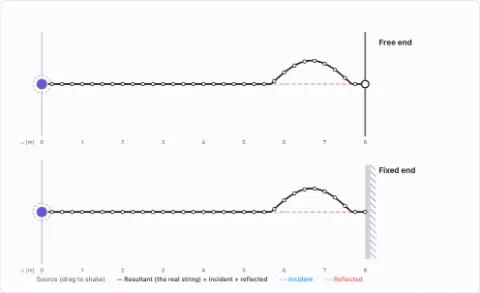
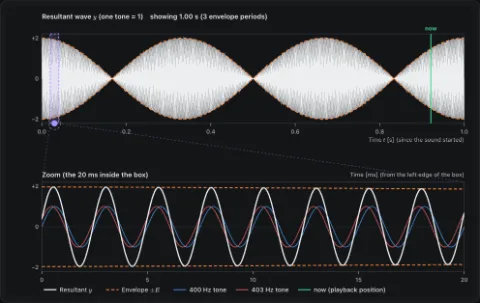
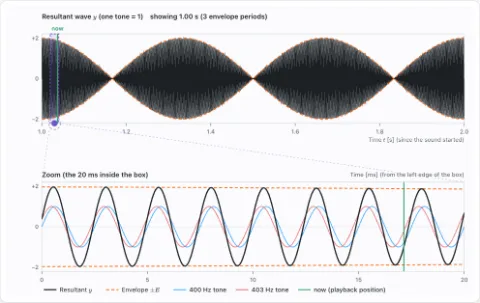
Two waves traveling in opposite directions interfere to make a standing wave; the nodes and antinodes in the "reflection of waves" simulation are a one-dimensional cousin of the nodal and antinodal lines here. Beats, the throbbing of two tones with slightly different frequencies, are interference too, except that reinforcement and cancellation take turns in time rather than in space. Sound of exactly this kind was one of the doors through which Young came to the interference of light.
Particles or waves?
Is light a stream of particles or a wave? By 1700 both answers were on the table. In his 1690 Treatise on Light, Christiaan Huygens had every point of a wavefront send out new wavelets. This is Huygens' principle, and it explained reflection and refraction. Isaac Newton's Opticks of 1704 treated light as particles, even though Newton himself had carefully measured the colored rings formed in the thin film of air between a lens and a glass plate, down to the thickness of air at each ring. Helped by Newton's authority, the particle view is generally said to have dominated the 1700s.
The challenger, Thomas Young, was a physician who had studied how the eye focuses, the human voice, vibrating strings and pipes, and beats. Two notes played together swell and fade; could light be doing the same? By his own account, written a few years later, it was in May 1801, while reflecting on Newton's rings, that he hit upon the principle of interference. He presented it at the Royal Society in London that November, stated it more fully in 1802, and used Newton's measured thicknesses to work out a wavelength for each color. His table gives 0.0000266 inch for the extreme red and 0.0000167 inch for the extreme violet, roughly one 38-thousandth and one 60-thousandth of an inch. In modern units that is about 0.68 µm and about 0.42 µm. For the first time, the wavelength of light had a number.
Checking Young's rule with algebra
Young, an English scientist, was the first to state this rule clearly for light, in 1801 and 1802. In modern words: when light from the same source reaches a point by two different routes, it is brightest where the difference of the routes is a whole number of a certain length, and darkest halfway in between. That "certain length" is the wavelength. Let's check that the mathematics really says so.
First, a formula for one wave. Source moves as , where is its starting phase. That motion takes seconds to travel a distance at speed , so a point at distance repeats the source's motion seconds late. Writing as ,
Every extra wavelength of distance adds exactly one period of delay, a phase of .
Now add the two. With equal amplitudes , the identity does the work. Put and , and call the path difference , the phase difference , and the averages and . Then
and since a cosine doesn't care about the sign of its argument,
That looks fierce, but it reads easily. The sine at the back is the part that oscillates in time; the factor in front is the amplitude at that place, and it contains no at all. That's why the pattern stands still even though the waves themselves keep marching outward.
The amplitude is largest, , where , that is where , and zero where it equals , with an integer. Divide by and the rule reads: reinforcement where is a whole number, cancellation where it is a whole number plus a half. The two cases you'll meet most often:
| Sources | Reinforce (antinodal lines) | Cancel (nodal lines) |
|---|---|---|
| In phase () | ||
| Opposite phase () |
Here . The in-phase row is exactly the rule Young put into words.
The difference of two sides of a triangle is less than the third side, so the path difference can never exceed the separation of the sources. That's why the number of antinodal lines is set by : with there are five, .
Where does the missing motion go?
You might worry: "On a nodal line the energy has vanished. Where did it go?" It hasn't vanished. Energy goes as amplitude squared, so on an antinodal line, where the amplitude is , the energy is four times that of a single wave. The squared amplitude at each place is , and averaged over a region containing many fringes, averages to :
exactly the sum of the two waves' energies. Interference doesn't destroy energy; it moves it around.
One more ingredient: the waves weaken with distance. A circular wave on a surface spreads its energy around a circle of length , so stays constant and . Confession: this formula is good several wavelengths away from the source, not right next to it, so in this simulation the amplitude is simply capped within 2 mm of a source.
Two slits and a bright spot in a shadow
Now a confession, about an assumption hidden in all of this: the phase difference must stay fixed. If it wandered randomly, the pattern would slide back and forth and average away. That's why two candles don't make fringes: an ordinary light source scrambles its phase over extremely short times. Two candles are a duet in which neither singer ever keeps time with the other. It's also why Young's rule is about light from the same source.
For light, the classic pair of sources is Young's double slit. When the screen is far away compared with the slit separation , the two paths from S₁ and S₂ to a point P on the screen are almost parallel. Drop a perpendicular from S₁ onto the path from S₂, and the path difference is cut off as one side of a thin right triangle whose hypotenuse is .
In 1803 he held a narrow strip of card in a beam of sunlight and showed fringes inside its shadow; block the light passing one edge and the fringes vanish, so they come from two portions of light overlapping. His published lectures of 1807 describe fringes from two narrow slits and include his drawing of overlapping ripples from two sources, still reproduced in textbooks, although whether he actually performed the two-slit version is unclear. The reception was cold. In 1803 and 1804 the Edinburgh Review ran scathing anonymous attacks, later attributed to Henry Brougham, and Young's optics was largely ignored for more than a decade. Meanwhile he was working on the Rosetta Stone; by 1814 he had translated its demotic text.
The tide was turned by a French civil engineer, Augustin-Jean Fresnel. Suspended from his post in 1815, during Napoleon's Hundred Days, for trying to join the royalists, he spent the time at his mother's house and began experimenting with light. He combined Huygens' wavelets with Young's interference into a theory that could predict diffraction, and entered it in a prize competition of the French Academy of Sciences in 1818. One judge, Siméon Denis Poisson, a supporter of particles, deduced what he took to be an absurdity: a bright spot at the center of the shadow of a round obstacle. The committee chairman, François Arago, tried it with a metal disk about 2 mm across, and the spot was there. Fresnel won, and the spot is now called the Arago spot, or the Poisson spot. Poisson had fired a shot meant to sink the theory, and it went off as a salute to its victory. Arago himself noted that Delisle and Maraldi had seen it about a century before. It seems you can look straight at something and miss it if no theory says it should be there. A theory whose ridiculous-sounding prediction comes true: that's one of the best moments in science.
The story doesn't end with light. Even electrons behave this way: send them one at a time through a two-path apparatus and, after many arrive, interference fringes build up. In 1989 Akira Tonomura and colleagues at Hitachi filmed exactly this. Particles have wave properties, and that's the heart of quantum mechanics. Remember the sand, and you'll see why electron fringes are so strange.
Canceling noise, catching gravitational waves
Interference hides in a surprising amount of everyday technology. Noise-canceling headphones play the incoming noise back with opposite phase, so that the two cancel. The anti-reflection coating on a camera lens or a pair of glasses is a thin film whose thickness makes the light reflected from its top and bottom surfaces cancel.
And we can choose where the waves reinforce. Drive many antennas with slightly shifted phases and the direction of constructive interference can be steered electronically. These phased arrays are used in radar and mobile-phone base stations. When you move the phase-difference slider in this simulation and the whole pattern slides sideways, you are watching the same principle.
There's a link to mathematics as well. "The set of points whose distances from two fixed points differ by a constant" is the very definition of a hyperbola. Hyperbolic radio navigation, used from the Second World War on, locates a ship or aircraft from the difference in arrival times of signals from pairs of stations. The British Decca system compared the signals' phases instead, and points of constant phase difference lie on hyperbolas, the same geometry as the lines in this simulation.
Interference also lets us measure astonishingly small things. Split light into two beams, send them along different paths and recombine them, and the tiniest change in one path shows up as a shift of the fringes. In 2015 the LIGO interferometers, with arms 4 km long, made the first direct detection of gravitational waves this way; the change in arm length they pick up can be as small as a thousandth of the width of a proton. Radio astronomers play the same trick with radio waves, combining the signals from telescopes far apart so that they act like one telescope the size of the Earth; the image of a black hole's shadow released in 2019 was made this way.
The wavelength of light that Young first put a number on later became the standard of length itself. From 1960 to 1983 the meter was defined as 1,650,763.73 wavelengths, in vacuum, of a particular orange-red line emitted by krypton-86 atoms. Only interferometers, which count wavelengths, made such a definition usable. Today the meter is the distance light travels in vacuum in 1/299,792,458 of a second.
Overlap the waves yourself
- At the start, λ = 2.5 cm and d = 6.5 cm, so d/λ = 2.6. The green point P sits on the line labeled "Δ = 1λ". In the "Point P (drag to move)" section of the panel, "Verdict" should read "Constructive (antinodal line)".
- Drag P onto a dashed line. How many wavelengths does "Path difference " show now?
- Predict, then check: set "Source separation " to 12 cm. How many antinodal lines will there be? Use the "" readout to predict, then count.
- Set "Phase difference " to 180°. Does the center line reinforce or cancel?
- Under "Display", set "View" to "Crest and trough circles (textbook)". Crests become solid circles and troughs dashed circles. Which lines do the filled dots, where crest meets crest, sit on?
- Set "View" to "Time-averaged amplitude" and toggle "Decrease with distance (amplitude )". How do the dark nodal bands change, and why?
- Press "〰 Restart from the sources" to restart the waves and watch the pattern assemble itself.
The fine print: motion is shown at one sixth of real speed, and the displayed oscillation is capped at 3 cycles per second so that large areas don't flicker. The numbers for λ, f and v are real. Real water waves change speed with depth and wavelength; here the speed is fixed at 20 cm/s. The colors saturate for large displacements.
Only signed things add up to zero
Where two waves overlap, the displacement is simply the sum of the two. From that one rule we found that, for sources in phase, the waves reinforce where the path difference is and cancel where it is ; that the antinodal and nodal lines are hyperbolas with the sources as foci, their number set by ; and that interference doesn't destroy energy but redistributes it.
Why does such simple addition matter so much? Because only something with a sign, a wave, can add up to zero. That is how Young and Fresnel showed that light is a wave and measured its wavelength, which later defined the meter; today the same trick catches gravitational waves.
One last puzzle: two loudspeakers in a room playing the same sound should give loud and quiet spots as you walk around. Yet in an ordinary room you hardly notice. Why not? Here's a hint: walls reflect sound, and music contains many frequencies at once.
Sources and further reading
- Young, Thomas (Complete Dictionary of Scientific Biography, Encyclopedia.com)
- Thomas Young's Wave Experiments (Whipple Museum of the History of Science, University of Cambridge)
- O. Morizot, "The wavelength of light as Thomas Young invented it" (arXiv, 2026)
- What is an Interferometer? (LIGO, Caltech)
- First M87 Event Horizon Telescope Results. I (Event Horizon Telescope Collaboration, The Astrophysical Journal Letters, 2019)
- Resolution 6 of the 11th CGPM: definition of the meter (BIPM, 1960)
- Double-slit experiment (Hitachi Research & Development)
Further reading (encyclopedia):