Why does one ball knock out exactly one?
Five shiny balls hang in a row, each on its own string. Pull back the ball at one end and let it go. Click! The ball at the far end flies up to the same height, while the three in the middle barely move. Pull back two balls, and two fly out. Three, and three. You may have seen one on an office desk. It's called Newton's cradle.
It looks obvious, so let's ask an awkward question. When one ball hits at speed , why don't two balls fly out at speed ? Momentum would be fine: . So why does nature never choose that?
This question has exactly the shape of a great argument that split European scientists in the seventeenth and eighteenth centuries. Is the "amount of motion" a moving body carries its mass times its speed, , or its mass times the square of its speed, ? Find the two rules the cradle obeys, and you will see how that argument was settled.
A relay race for velocity
Start with just two balls of equal mass. One moves at speed and hits the other, which is at rest. Afterward the first ball stops and the second moves off at . It's the same as a head-on shot in billiards, where the cue ball stops dead. The velocity is handed over completely.
In a cradle of five, there are tiny gaps between the balls. Even when they touch, the force passes from ball to ball in turn. So ball 1 hands its velocity to ball 2, which hands it to ball 3, and so on, like a baton in a relay. Ball 5 has no one to pass to, so it flies off. The middle balls pass the baton on almost at once, so they hardly move.
When you release two balls, ball 2 strikes ball 3 first and sends one baton down the line; a moment later ball 1 strikes ball 2 and sends a second. Two batons arrive at the far end, and two balls fly out. Now back to our question: why not two balls at ? The answer is energy.
Searching for the rules of collision
To check that answer we need the rules of collision, and finding them took surprisingly long.
The first serious attempt to write down the laws of collision was made by René Descartes in the seventeenth century. In his Principles of Philosophy of 1644, he held that the total "quantity of motion" in the world, size times speed, never changes, and from it he derived seven rules of collision. It was a grand attempt to explain the whole universe from one principle, but most of the rules did not match real collisions. One of them said that if a body at rest is even slightly larger than the body that hits it, the smaller body can never move it, however fast it comes, and simply bounces back. A few minutes with billiard balls shows something is wrong.
In 1668 the Royal Society in London took up the laws of collision, and three people sent answers: the mathematician John Wallis; Christopher Wren, also famous as an architect; and the Dutchman Christiaan Huygens. Wren said he had worked out his theory around 1660, when the Society was founded, and that the late Lawrence Rooke had tested it by experiment. Huygens had in fact found his rules in the 1650s, and his method was beautiful. Imagine a man on a boat gliding at steady speed along a canal, watching two equal balls collide. The laws of physics must be the same on the boat as on the bank. Using that idea, that changing your point of view doesn't change the laws, he derived the general rules of collision. He also saw that in elastic collisions the total of is conserved. That treatise was published only in 1703, after his death.
Two rules, written as equations
Getting it right took two rules. The first is conservation of momentum, and it follows from Newton's laws. While the balls touch, they push on each other with forces and , equal and opposite: action and reaction. A change in momentum equals the impulse received, which is force times time, so the two momenta change by and , which add to zero. During the brief instant of a collision no outside force has time to act, so the total momentum doesn't change. Momentum has a direction: if rightward is positive, leftward counts as negative when you add. The second is the coefficient of restitution : the speed at which the two balls separate is times the speed at which they approached. If , kinetic energy is conserved too, and the collision is called elastic.
Around 1670 the Frenchman Edme Mariotte recorded experiments with balls hung on strings knocking into one another, the earliest known experiments of the kind a Newton's cradle shows. In the Principia of 1687, Isaac Newton mentioned Mariotte's work and made his own tests with suspended balls. For balls of tightly wound wool, the speed of separation was about 5/9 of the speed of approach; for steel, almost the same as the approach speed; for glass, about 15/16. In today's language, he measured the coefficient of restitution of different materials, and he used the results as evidence that action and reaction are equal. Incidentally, the cradle is named after Newton, but he didn't invent it. The name is said to have started in 1967, when the British actor Simon Prebble named a version "Newton's Cradle" and began selling it.
Let's solve the two-ball case: mass at speed hits an equal mass at rest. Two unknowns, two equations: the simultaneous equations of middle-school algebra, nothing scarier. Call the velocities afterward and . Then
Divide the first equation by , add the two equations, and you get ; subtract the second from the first and . So
With , and : the velocities swap.
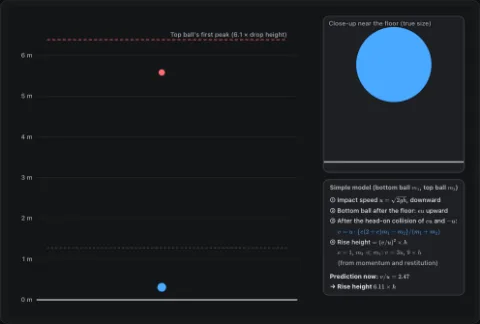
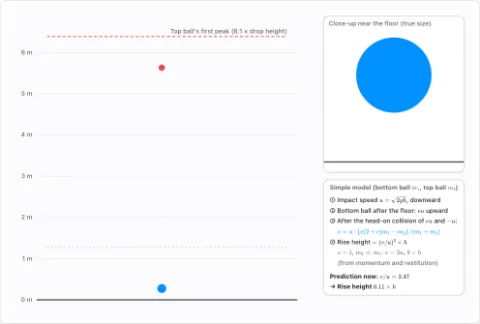
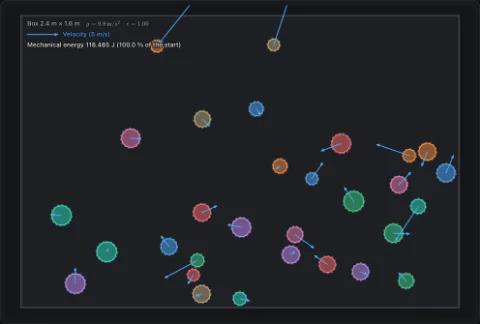
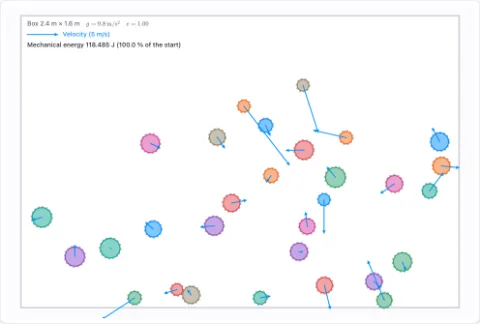
Change the masses and the story changes completely. When a heavy ball hits a light one, the velocities don't simply swap: the light ball shoots off faster than the ball that hit it. That's why, in the stacked-ball bounce simulation, a small ball resting on a big one bounces several times higher than it was dropped. And when balls meet at an angle, as in the many-ball collision simulation, only the velocity along the line of centers changes, so two equal balls with one at rest fly apart at a right angle. What happens if just one ball in the cradle is heavier? We'll work that out later.
Why not two balls at half speed?
Now test the "two balls at " idea. Momentum: . It passes. Kinetic energy: before, ; after, . Half of it has vanished. Balls with don't lose energy, so this idea fails. The only outcome that satisfies both momentum and energy is "one ball out at speed ." So and were never rivals for a single title. Both are conserved; they are two different quantities.
| After the collision | Total momentum | Total kinetic energy |
|---|---|---|
| Before (one ball hits at ) | ||
| Option A: one ball leaves at | (same) | (same) |
| Option B: two balls leave at | (same) | (halved) |
Historically, though, getting there took a long argument. In 1686 Gottfried Wilhelm Leibniz argued that the "force" of a moving body should be measured not by Descartes' quantity but by , later called vis viva, "living force." In 1722 the Dutch physicist Willem 's Gravesande dropped brass balls from various heights into soft clay and showed that the dents depended not on the speed but on the drop height, which is proportional to the square of the speed. In France, Émilie du Châtelet combined Leibniz's idea with these experiments and argued that living force goes as the square of the speed. In the end it became clear, just as our equations show, that , which has a direction, and , which does not, are conserved separately. In the nineteenth century the idea grew into the law of conservation of energy, heat included.
Huygens' idea that the laws are the same on the boat as on the bank is Galileo's principle of relativity, and it later became a starting point for Einstein's relativity. The rules of collision must look the same from every steadily moving point of view. In fact, if you demand that energy be conserved from every such point of view, conservation of momentum follows. The two conservation laws concern different quantities, but deep down they are linked.
Designing how hard things bounce
What if is less than 1? As the formula shows, the ball that hits does not stop completely; it keeps moving a little.
In curling, where the stones have equal masses, nearly the same happens as in billiards; the collision isn't perfectly elastic, so the thrown stone keeps moving a little. The coefficient of restitution even appears in the rules of sport: in golf, so that a driver cannot act like a spring and fling the ball too hard, its face has an upper limit on the coefficient of restitution. The rule began in the United States in 1998 at 0.822, or 0.830 including the test tolerance, and today a limit of 0.830 applies worldwide.
In car crashes we want the opposite: to absorb energy. The front and rear of a car are designed to crumple, lowering and turning kinetic energy into deformation and heat so that less of the shock reaches the passengers. Momentum is still conserved; the energy is what gets dissipated. The engineer who turned this into a design was Béla Barényi of Mercedes-Benz: a rigid passenger cell with crumple zones in front and behind. The patent was filed in 1951, and the idea first reached a production car in 1959. Today cars all over the world are built on the same principle.
What if all five collide at once?
But let's be honest about something. If all five balls were touching and collided all at once, we'd have five unknown velocities and only two equations. That isn't enough to fix the answer! It is like being asked to guess five students' test scores knowing only the total and the sum of the squares of the scores. Momentum is a sum of velocities and energy a sum of squared velocities, so the analogy matches even the form of the equations. Plenty of answers fit. What decides it is that the force is passed on two balls at a time. For each pair there are two unknowns and two equations, and the answer is fixed. This simulation computes exactly that: a sequence of two-ball collisions. Real balls dent slightly when they hit, and the force travels through them as a wave, a bit like sound, so in a real cradle the other balls move a little too.
The theory of how balls deform and push on each other when they touch came from Heinrich Hertz at the age of 24. Working in Berlin as Hermann von Helmholtz's assistant, he became curious, through experiments on optical interference between glass lenses pressed together, about how pressed bodies dent, and in the early 1880s he worked out the theory of contact between elastic bodies. A collision between steel balls like these lasts only about a tenth of a millisecond.
The way the force passes from ball to ball is the same physics as sound traveling through a solid: it's a wave. Rows of balls are also at the research frontier. In 2010 researchers at Caltech built what they described as a longer version of Newton's cradle: 21 chains, each of 21 stainless-steel balls 9.5 mm across. By adjusting how hard the balls in each chain are pressed together, they could focus waves to a point and make intense "sound bullets." They hope such lenses may one day help in medical imaging and therapy, though for now it is a proof of principle.
What if the middle ball is heavier?
Here's another awkward question. Suppose that of the five balls, only the middle one, ball 3, has twice the mass of the others. What happens when you release one ball? Think of a ball of the same size made of a material twice as dense. If one runner in the relay is heavier, does the baton still pass cleanly?
To find out, we need the collision of two unequal balls. A ball of mass moving at speed hits a ball of mass at rest. The two rules are the same as before:
Rewrite the second equation as and put it into the first: . Solve for , put it back into the second equation, and you get
Set and you are back to and . With , the hitting ball stops dead, , only when . The velocity baton is handed over whole only between equal masses.
Now let the other balls have mass and ball 3 have , and send ball 1 in at speed with . There are tiny gaps between the balls, so we can solve the collisions two balls at a time, in the order they happen. Rightward counts as positive.
| Collision | Velocities of the two balls afterward |
|---|---|
| 1 → 2 | ball 1: , ball 2: |
| 2 → 3 | ball 2: , ball 3: |
| 3 → 4 | ball 3: , ball 4: |
| 4 → 5 | ball 4: , ball 5: |
| 2 → 1 | ball 2: , ball 1: |
| 3 → 4, second time | ball 3: , ball 4: |
Ball 2 bounces off the heavy ball 3, runs back into ball 1, which had stopped, and sends it off to the left. Ball 3 can't pass on its baton in one go; it lumbers after ball 4 and pushes it a second time. In the end, ball 1 moves left at , ball 2 is at rest, and balls 3, 4 and 5 move right at , and . Ball 5 still flies out, but at only eight ninths of the incoming speed. The height a pendulum rises to goes as the square of its speed, so ball 5 reaches of the starting height, about 79%.
Let's check. Adding up balls 1 to 5, the momentum and the kinetic energy are
Both rules are kept.
Now notice something curious. "Only ball 5 leaves, at speed , and the rest stay still" also satisfies both momentum and kinetic energy . Yet the calculation doesn't pick it. As we saw in the last section, the two rules alone don't fix the answer; what fixes it is the chain of two-ball collisions. In a row of equal balls, every collision is a complete swap, so the chain happens to land exactly on "one ball out at the same speed."
Do the same calculation with a middle mass , and ball 5 leaves at . That factor can be rewritten as , so it equals 1 only when . And swapping and doesn't change it, so making the middle ball twice as heavy or half as heavy sends ball 5 out at the same . Too heavy or too light, the baton doesn't pass cleanly.
The forms and are, in fact, the same as for a wave reaching the joint between two different strings, where part of it reflects and part goes through. In place of mass you have a quantity called the impedance, set by the string's mass per meter and its tension. Reflection at a fixed end, as in the wave reflection simulation, corresponds to bouncing off an infinitely heavy ball, which reverses the velocity.
The story doesn't end with the first chain of collisions. The balls swing at different speeds, come back and collide again. Run it in the simulation and within two seconds the five balls seem to be swinging every which way. One more honest note: this calculation assumes there are gaps and that each collision is over before the next one starts. In a real cradle with the balls pressed together, the balls deform and the force reaches several balls at once, so the numbers can come out a little differently.
A pendulum between collisions
Between collisions each ball swings as a pendulum. With swing angle and string length , the component of gravity along the circle is , always pointing back toward the bottom, and the acceleration along the circle is , so . For small swings, with in radians, , and has the same form as a mass on a spring, with angular frequency and period . Wide swings have a slightly longer period; working that out goes a little beyond high-school physics, so the number is only quoted at the end of this section. In short,
which is about 1.10 s for a 0.30 m string. While the balls swing, gravity and the string tension act on them, so the total momentum keeps changing: it is largest at the bottom and zero at the ends. Momentum is conserved only across the instant of a collision. Mechanical energy, with , is conserved all the time. The two graphs in the panel show the difference.
It's also worth remembering that a pendulum's period depends only on the string length and , not on the mass, so balls on equal strings keep the same rhythm. Larger swings do take slightly longer, about 1.7% longer at 30°.
Release the balls yourself
- Press "↖ Lift and release 1 ball". In the bar charts below the cradle, watch the energy move from ball 1 to ball 5. Set the playback speed in the toolbar to ×0.1 to see the collisions.
- Read the line at the top of the picture, which compares momentum and kinetic energy just before and after the latest collision. Do the totals change?
- Before pressing "2 balls" and "3 balls", predict how many balls will fly out.
- Set "Coefficient of restitution e" to 0.9, press "↖ Lift and release 1 ball", and wait about 20 seconds. What happens to "Ratio to the start"? How do the balls move in the end?
- Set "Gap between balls" to 2 mm or more and press "2 left + 1 right". Watch for about 30 seconds. Does the middle ball stay still? What if the gap is 0?
- Set "Gap between balls" back to 0.2 mm and "Middle ball mass" to 2.0. Before pressing "↖ Lift and release 1 ball", predict what percentage of the starting height ball 5 will reach. Set the playback speed to ×0.1 and read ball 5's share in the "Mechanical energy of each ball" bar chart. What about 0.5?
- Why isn't the "Total momentum" graph constant? Compare it with the "Total mechanical energy" graph.
- Drag a ball by its dashed ring to lift it, and let go.
What the model assumes: collisions are instantaneous and happen two balls at a time. is an ideal value; real steel balls have slightly below 1. Strings don't stretch, and there is no air resistance. Real cradles hang each ball from two strings in a V to keep it in one plane; here one line is drawn. Changing the middle ball's mass does not change its size, in the drawing or in the calculation.
The two rules the cradle keeps
During a collision momentum is conserved, and with kinetic energy is too. In an elastic collision of equal masses the velocities swap, and passing that swap along two balls at a time sends out the same number of balls at the far end. Put one ball of a different mass in the middle and the swap is no longer complete: both rules still hold, but the velocity is shared out among other balls too. "Two balls at half speed" keeps the momentum rule but breaks the energy rule. And while the balls swing, total momentum is not conserved, because gravity and string tension act on them. Knowing when, and over what interval, a conservation law holds is half the physics.
From Descartes' mistaken rules to the Royal Society's comparison of answers, Newton's wool and glass balls, and the long quarrel over versus , the desk toy holds the story of how people learned that momentum and energy are two separate conservation laws. That understanding now lives on in car safety and in research on sound.
A last puzzle: how many times heavier or lighter must the middle ball be for ball 5 to leave at three quarters of the incoming speed? Solving the equation gives two answers. You can check one of them with "Middle ball mass"; the other lies outside the slider's range. How are the two answers related?
Sources and further reading
The facts in this article were checked mainly against these sources.
- Mechanics and the Royal Society, 1668–70 (The British Journal for the History of Science, Cambridge University Press)
- Wren, "Lex naturae de collisione corporum" (Royal Society archives)
- Mechanical Supertasks: Huygens' boat (J. D. Norton, University of Pittsburgh)
- R. Cross, "Mariotte's Cradle" (University of Sydney)
- Newton, Principia, 1846 English translation: Axioms, or Laws of Motion, with the Scholium (Wikisource)
- Newton's Philosophiae Naturalis Principia Mathematica (Stanford Encyclopedia of Philosophy)
- The vis viva dispute: A controversy at the dawn of dynamics (Physics Today)
- K. L. Johnson, Contact Mechanics, Preface (Cambridge University Press; on Hertz's theory of contact)
- Driver Head Coefficient of Restitution and/or Characteristic Time (on the golf rule)
- Crumple zones (Physics Today)
- Knautschzone (German Patent and Trade Mark Office exhibit, in German; the 1951 patent application and the 1959 W111)
- Caltech Researchers Create "Sound Bullets" (Caltech, 2010)
- Spadoni & Daraio, "Generation and control of sound bullets with a nonlinear acoustic lens," PNAS 107 (2010) (PMC)
Further reading (encyclopedia articles):