Billiard balls that split at a right angle
Have you ever hit a billiard ball into a stationary one at an angle? If you do it cleanly, the two balls run off at very nearly a right angle to each other. That's no accident. Whenever two equal masses collide elastically and one starts at rest, it happens.
In this simulation, many balls of different sizes bounce around a box under gravity. It looks like a lively toy, but what's going on inside is remarkably orderly. Through hundreds and thousands of collisions, some quantities are kept exactly, and others are gradually lost. Which are which, and why? Let's grab some balls, throw them, and find out.
As it happens, "lots of balls bouncing around in a box" is exactly the picture that physicists of the eighteenth and nineteenth centuries carried in their heads when they asked what a gas is and what heat is. One paper built on that picture was turned down for publication and lay forgotten in an archive for almost half a century. There is a good deal of history in this noisy box.
One collision: what changes and what doesn't
Look closely at a single collision. When two smooth balls touch, they push on each other perpendicular to their surfaces at the point of contact, that is, along the line joining their centers. If the surfaces are smooth, there is no force in the tangential direction, along the surface.
That tells us three things. The velocity components along the line of centers, called the normal direction, change because of the push. The tangential components don't change, because there is no tangential force. And the forces the two balls exert on each other are an action–reaction pair, equal and opposite, so the sum of their momenta doesn't change.
How bouncy the collision is depends on the coefficient of restitution . The speed at which they separate along the normal is times the speed at which they approached. With no kinetic energy is lost, and the collision is called elastic. With , the lost energy turns into deformation, heat and sound. Between collisions each ball simply follows a parabola, and when it hits a wall, the floor or the ceiling, it bounces back with the same coefficient of restitution.
Find the impulse, and the right angle follows
During the instant of contact the force changes in complicated ways we don't really know. Never mind: all we need is the force added up over the time of contact, the impulse . Know and you know the velocities afterward, so finding is the whole job. Let balls of mass and with velocities and collide. Let be the unit vector along the line of centers, and the relative velocity along it, so that means they are approaching. Give the two balls equal and opposite impulses of size along :
The total momentum is conserved because the impulses cancel. Using , the normal relative velocity afterward is . Setting this equal to the restitution rule and solving for gives
The tangential velocities don't change. You can check that with the total kinetic energy is conserved too. By the way, the collision calculation itself is a direct use of something from your mathematics class: the dot product, which picks out the component of a vector along the line of centers.
Now let's prove the billiard-ball fact. Take equal masses, one at rest so that , and an elastic collision. Momentum and energy conservation give
Square the first equation, that is, take its dot product with itself, to get , and compare it with the second: you get . The two final velocities are perpendicular, or else one of them is zero. Splitting at a right angle is the signature of momentum and energy both being conserved.
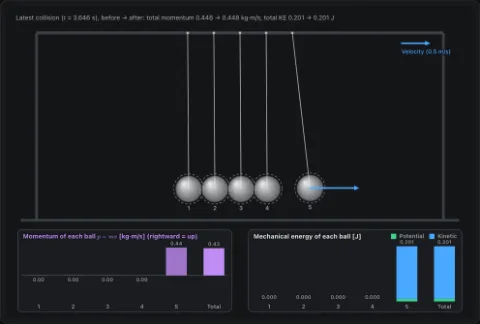
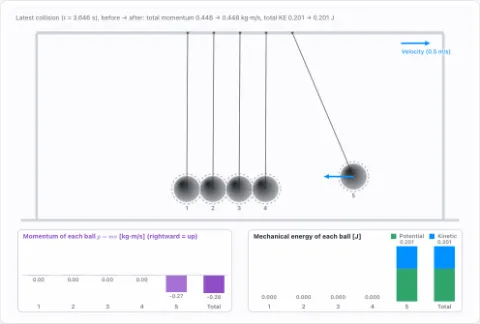
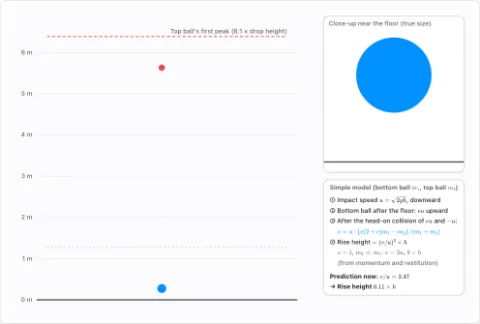
If you want to see collisions in one dimension, try Newton's cradle: equal balls meeting head-on swap velocities, and the swap is passed down the row like a baton. To see what unequal masses do, try the stacked-ball bounce, where a small ball resting on a big one shoots up several times higher than it was dropped. In this box, both kinds of event happen in two dimensions, thousands of times over.
Accident investigators sometimes use conservation of momentum to estimate how fast cars were going before a crash, from the masses of the cars and how far and in which directions they moved afterward.
What is wrong with swapping momenta?
Let's look at one plausible-looking but wrong calculation. It is the rule you get by choosing "Swap momenta (wrong, for comparison)" under "Collision rule", and it is there only so you can compare. It turns the two balls' velocities with an ad hoc formula and then simply swaps their momenta, multiplying them by the restitution coefficient .
Take a head-on collision first. The swap gives and , so for the total momentum is kept. With equal masses the balls just exchange velocities, which matches the correct answer. So far it looks like a sensible rule. But with unequal masses the kinetic energy after the collision is
which does not match the energy before. Suppose a 0.5 kg ball moving at 2 m/s hits a 0.2 kg ball at rest. With the swap, the heavy ball stops dead and the light one shoots off at m/s. The kinetic energy jumps from 1.0 J to 2.5 J, two and a half times as much. With the correct rule and , the formula for above sends the heavy ball on at 0.86 m/s and the light ball at 2.86 m/s, and the energy stays at 1.0 J.
Glancing collisions are worse. The ad hoc turning formula ignores the fact that the force acts along the line of centers , so it changes the tangential velocity too, and sometimes even the total momentum is not kept. On top of that, this rule always bounces the balls off the walls with a coefficient of 1, so the slider then affects only ball-to-ball collisions.
So where does it go wrong? To find the velocities after a collision you need both momentum conservation, which says the impulses on the two balls cancel, and the restitution equation, which says the relative velocity along is multiplied by . In a glancing collision, the fact that the force points along also tells you that the tangential velocities do not change. The swapping rule replaces the restitution equation and the direction of the force with a promise that has no physics behind it. That is why it happens to work in one special case, equal masses colliding head-on with , and breaks the conservation laws everywhere else.
To compare the two rules, set to 0 and to 1. The walls then bounce with a coefficient of 1 under both rules, so the only difference left is the ball-to-ball collision formula. With the correct rule the "Total mechanical energy" should stay constant, so if the "Total" line in the graph starts to wander up and down, that is the wrong formula giving itself away. Under "Last collision" in the results you can also see the total momentum and kinetic energy of the pair change from before to after.
Countless impacts add up to pressure
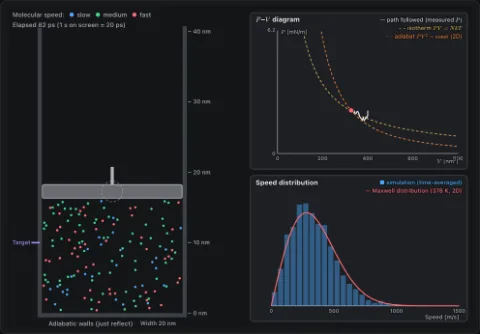
Next, think about how many balls push on a wall. This is physics' answer to the question "what is the pressure of a gas?" In the air of your room, about molecules hit each square centimeter of wall every second, so the separate impacts blur into a smooth, constant pressure. The calculation below ignores collisions between the particles; real molecules do crash into one another on the way, but averaged over time the result is the same formula. In a box of side , let a particle of mass move back and forth with speed perpendicular to one wall. Each time it hits that wall, the wall receives momentum , and it comes back to the same wall every seconds, so its average push on the wall is . Add this up over particles and use the fact that in three dimensions . The pressure in a box of volume is then
In this simulation's two-dimensional box, a 2 takes the place of the 3. If the temperature is fixed and the average kinetic energy of the particles doesn't change, is constant. That is the relation between the pressure and volume of a gas, Boyle's law. A law about gases you can see comes out of collisions of particles you can't.
Getting to this calculation took a long time. The laws of collision themselves became clear in the seventeenth century, and the Newton's cradle simulation tells that story. Around the same time, in 1662, Robert Boyle showed by experiment that the pressure of trapped air is inversely proportional to its volume. Why that should be so, nobody knew.
In his Hydrodynamica of 1738, the Swiss mathematician Daniel Bernoulli pictured a gas as a great many small particles, calculated the force of their impacts on a movable piston, and derived Boyle's law: the ancestor of the calculation above. His picture also tied heat to the motion of the particles. But at the time most people thought of heat as an invisible fluid, later called caloric, and there was no way to measure the speeds of particles, so the idea attracted little attention.
Heavy balls amble, light balls dart
Here's another lovely property. Turn gravity off, keep , and let the balls collide for a long time. The heavy balls and the light balls end up with the same average kinetic energy , so the heavy balls amble while the light ones dart about. This is called equipartition of energy. Proving why it happens goes beyond high-school physics. Maxwell and Boltzmann did it with probability, so here we check it in the simulation. It is also the reason heavy gas molecules move more slowly than light ones at the same temperature. Compare the formula above with the ideal gas law and you find that temperature is proportional to the average kinetic energy of the particles.
The box also connects to the gas laws of chemistry. Once you know that pressure comes from particle collisions and that temperature is set by the average kinetic energy of the particles, Boyle's law and Charles's law can be translated into the language of moving particles.
This is where the paper mentioned at the start, the one that lay in an archive, comes in. In 1845 the Scotsman John James Waterston sent the Royal Society in London a paper setting out a theory of gases made of elastic molecules in motion. It contained what amounts to equipartition of energy: in a mixture of gases with molecules of different masses, the average kinetic energies become equal. The paper was refused, and only a brief abstract appeared. The manuscript was never returned, and Waterston had kept no copy. It was Lord Rayleigh, who later won the 1904 Nobel Prize, who found it in the Society's archives and published it in 1892, acknowledging that it had marked an immense advance toward the theory now accepted.
Meanwhile, in 1860, James Clerk Maxwell treated collisions between elastic spheres with the tools of probability and derived how the speeds of gas molecules are distributed; he also studied mixtures of particles of different masses. Ludwig Boltzmann extended these ideas enormously, and the kinetic theory of gases and statistical mechanics were born.
Are atoms real?
Even so, some scientists still doubted, into the early twentieth century, that atoms and molecules really exist. The question was settled by Brownian motion, the jittering of tiny particles in water as molecules strike them. Albert Einstein worked out its theory in 1905, and in 1908 the French physicist Jean Perrin confirmed it by experiment, work that earned him the 1926 Nobel Prize in Physics.
In the mid-twentieth century researchers began using computers to follow thousands of collisions between hard spheres to study liquids and solids, a method now called molecular dynamics. In 1957 Berni Alder and Thomas Wainwright published calculations strongly indicating that even hard spheres with no attraction at all, which simply bounce off one another, change from a liquid-like to a solid-like state when packed tightly enough. In a sense, this simulation is a tiny version of that.
Molecular dynamics is now an essential tool in drug development and the study of proteins. The 2013 Nobel Prize in Chemistry went to Martin Karplus, Michael Levitt and Arieh Warshel, who in the 1970s laid the foundations of methods that treat most of a large molecule with Newton's laws and only the reacting part with quantum mechanics. Balls bouncing in a box are where that kind of computation starts.
Sand grains and Saturn's rings
So far we have mostly looked at collisions with . What happens when many collisions with pile up?
Flowing sand and powders, known as granular materials, are collections of grains colliding inelastically. Because energy is lost in every collision with , granular materials behave differently from gases. Shake a container of grains of different sizes, for example, and the large ones work their way to the top. It is called the Brazil nut effect, after the big nuts that end up on top of a can of mixed nuts, and in 1987 its mechanism was studied with computer simulations. Factories that need to mix powdered medicines or foods evenly find this separation a nuisance, and calculations like these are used to design their machines.
In space, Saturn's rings are a fine example. Collisions between ring particles lose energy and damp out their up-and-down motion. As a result, the rings span tens of thousands of kilometers, yet in most places they are only about 10 meters thick.
Throw some balls yourself
- At the start, and m/s². Is "Total mechanical energy" in the results, and the matching line in the "Energy [J]" graph, constant? Do kinetic and potential energy trade places?
- In the results, the two "Last collision" rows compare the total momentum and the total kinetic energy of the two balls in the latest collision, before and after.
- Set "Coefficient of restitution (balls and walls)" to 0.8. What happens to the energy graph? What happens to the balls in the end?
- Set "Coefficient of restitution (balls and walls)" back to 1 and "Gravitational acceleration " to 0. The balls from step 3 are resting on the floor, so press "Replace all the balls" to throw in a new set. Watch "Mean kinetic energy" and "Mean speed", the two rows comparing the lightest third and the heaviest third of the balls. Right after the throw, the heavy balls have more energy. What happens? With 30 balls the change takes only about a second, so set the playback speed on the toolbar to ×0.1 first to see it happen. Then keep watching for a minute or two.
- Drag a ball marked with a dashed ring and throw it at another one at an angle.
- Switch "Collision rule" to "Swap momenta (wrong, for comparison)" and watch the energy graph. What goes wrong? The answer is in "What is wrong with swapping momenta?" above, and the link in the panel note takes you there. Switch back to the correct rule when you have finished comparing.
What the model assumes: the balls are smooth rigid spheres with no spin or surface friction. A real superball spins, which changes its sideways speed in an oblique collision. Collisions are instantaneous and happen two at a time. There is no air resistance.
What the noisy box tells us
When smooth balls collide, the force acts only along the line of centers, so tangential velocities are unchanged and the normal relative velocity is multiplied by . In every collision the total momentum of the two balls is conserved, but kinetic energy is conserved only when . When equal masses collide elastically and one is at rest, they separate at a right angle. And after many collisions, the average kinetic energy becomes the same whatever the mass.
From this picture of many colliding balls, Bernoulli derived the pressure of a gas, Waterston and Maxwell found equipartition and the distribution of speeds, and Perrin's experiments confirmed that atoms are real. Today the same way of thinking underlies everything from computing drug molecules to understanding Saturn's rings.
A last puzzle: with and gravity on, do the balls crowd toward the bottom of the box? Are the balls near the top slower or faster than those near the bottom?
Sources and further reading
The facts in this article were checked mainly against these sources.
- Flamm, "History and outlook of statistical physics" (arXiv, 1998; on Bernoulli's gas model in Hydrodynamica)
- Every cloud (Royal Society blog, 2023; on Waterston's rejected paper)
- John Waterston (MacTutor, University of St Andrews)
- Maxwell, "Illustrations of the Dynamical Theory of Gases" (1860) (J. D. Norton, University of Pittsburgh)
- Jean Baptiste Perrin – Facts (Nobel Foundation)
- Alder & Wainwright, "Phase Transition for a Hard Sphere System," J. Chem. Phys. 27 (1957) (course material, City College of New York)
- Press release: The Nobel Prize in Chemistry 2013 (Nobel Foundation)
- Rosato et al., "Why the Brazil nuts are on top: Size segregation of particulate matter by shaking," Physical Review Letters 58 (1987) (New Jersey Institute of Technology research portal)
- Tremaine, "A few of Michel Hénon's contributions to dynamical astronomy" (arXiv, 2014; inelastic collisions keep Saturn's rings thin)
- Cassini: Saturn Rings (NASA; the rings are generally about 10 m thick)
Further reading (encyclopedia articles):